“See yourself as others see you”
A workshop teaching self-awareness and better social skills
Most of us move through the world with a significant blind spot: we can’t directly observe our own impact on others. We know our intentions, but we rarely get honest feedback about how we actually come across.
(Most of us? All of us!)
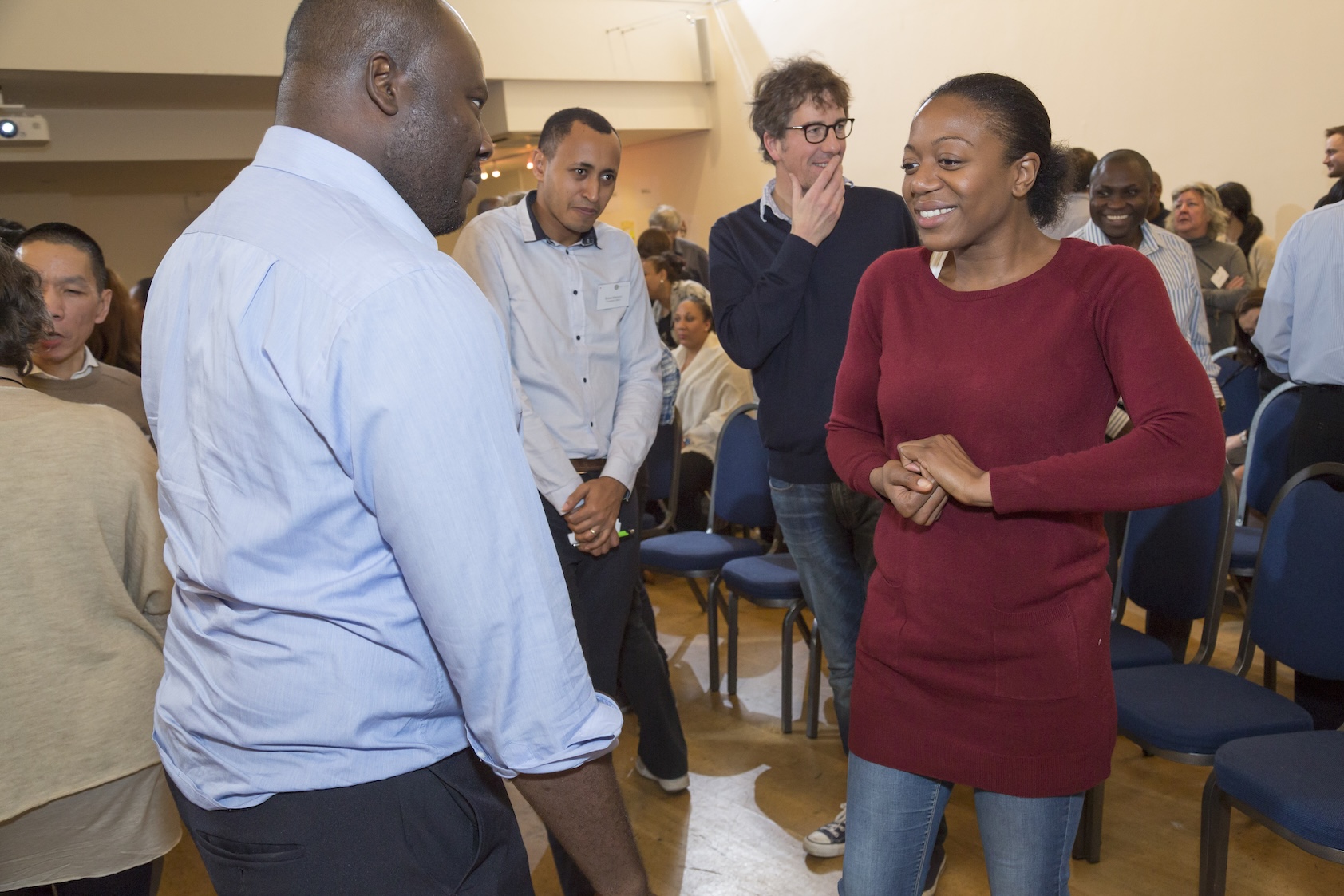
These people were role-playing awkwardness.
The problem we don’t see
This gap between self-perception and how others experience us creates:
- Misunderstandings that damage relationships
- Missed opportunities for connection and influence
- Repeated patterns we don’t recognize in ourselves
- Workplace friction that seems mysterious or unfair
- Leadership challenges where our message doesn’t land as intended
Most feedback comes too late, too vague, or too loaded with judgment to be useful. Annual reviews tell you what happened months ago. Friends are too polite to be specific, enemies too harsh to be credible. And we’re all trained to be “nice” rather than helpful.
Workshops make this obvious
Recently, I ran a workshop on this topic for a large corporate law firm, designed to help participants consider their own impact and presence.
Typically, in workshops like this, I ask participants to share stories of interactions that may not have gone quite as they wished (understatement!). And often those interactions turn out to have a lot to do with status roles, projection, and transactional conversations involving offers and blocks.
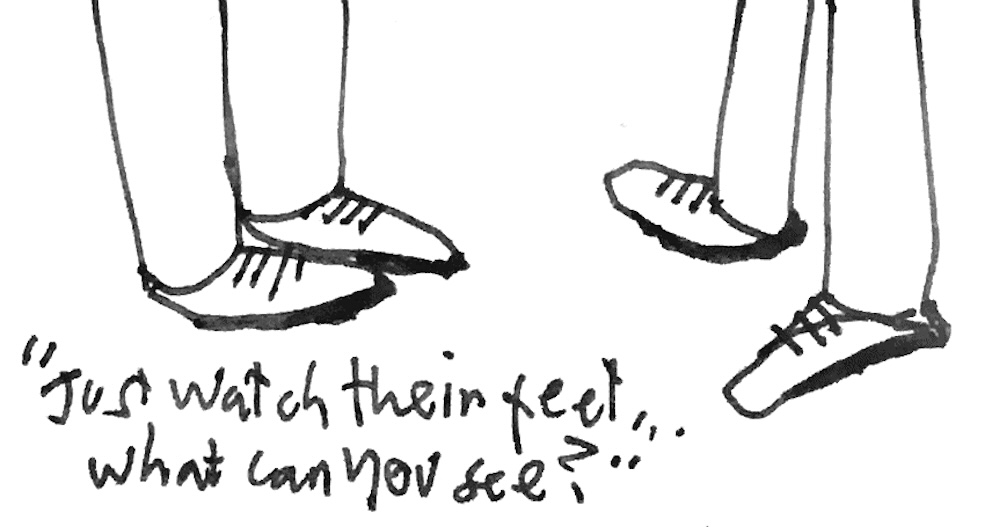
A sketch I made during a similar workshop.
The workshop creates something rare: a safe space to witness yourself in action, through others’ eyes, without shame or judgment. By watching someone else enact one of your own recent interactions, you gain:
- Immediate insight into your body language, tone, and word choice
- Compassionate distance from your own behaviour
- Specific, actionable observations from trusted peers
- Permission to experiment with different approaches
- Recognition of patterns you couldn’t see from inside the experience
***
When the workshop can’t come to you
Not long after mentioning this workshop on LinkedIn, I received a message from Ali Janighorban, a student I’d met at Cambridge. He’d been thinking about what I wrote, and wanted to bring it to his own community of teachers, undergraduates, graduate students.
Could I run it online? Could I just share the exercises? My first instinct was to say no. This really is one of those things that only works face-to-face. But Ali’s question made me realise something important: people need this kind of reflective practice everywhere, not just in formal workshops with professional facilitators.
So instead of simply declining, I tried something different. What if I could give Ali, and anyone else reading this, enough guidance to try it themselves?
I sent him a couple of voice messages (LinkedIn limits them to 59 seconds each) where I talked him through the core exercise. Ali tried it with his group. And it worked.
Here’s what we discussed, and what happened next.
Messaging Ali on LinkedIn

Ali Janighorban: I wanted to ask about a workshop you had a while ago in London. It was about seeing yourself how others might, if I’m not mistaken. Could you do one online? Or could you share the exercises in the workshop?
Me, JPF: Hello Ali I’d help if I could but it really is one of those things that only yields benefit if you are in the same room with other people. Something about physical proximity allows us (humans) to “see” ourselves with a particular (not unkind but instructive) self-consciousness. I hadn’t quite realised how important that is until you asked. So: thank you for asking!
Ali: Thank you. Do you have any advice for “seeing” and encouraging others to “see?” I would love to test the advice with teachers or undergrads or graduate students. Other specimen are more difficult to find.
JPF: Hi, Ali, I’m going to try and leave a voice message, because I’m finding typing here quite difficult.
[ Audio recordings and transcripts follow. ]
The thing to do, really, is to create a group where it’s possible for people to feel confident that they won’t be judged or criticised, and then ask if anyone wants to role play something that happened to them recently that was a social interaction.
For example, your boss said something unkind, or you had an exchange with someone in a shop, or someone you know asked you something that was difficult, a very short exchange like that, and then see if you can play it again.
Have someone else play the part of the person who had that exchange. So don’t let them be in it themselves, and let them just watch what happened and then ask the rest of the group how they might have done something a little bit differently. It can be their body language, or it could be the words.
The thing that’s most important is creating the safe space. And generally, I find that it’s best for me to tell everyone that they can’t do anything wrong, that if anything feels wrong, it’s because I haven’t explained something, so that they don’t feel under any pressure to do the right thing, and then they can be relaxed.
And then to ask for a volunteer to give the demonstration, the event, the incident, and someone will come up with something, and you ask them to describe what that thing was, what happened.
And then when they’ve said it a couple of times, you ask if other volunteers will perform the incident. And that’s when you ask the person themselves, does this look right? Does this sound right? Is this how it went?
And then you say to the rest of the room, what could have happened differently? How could anyone have changed anything? And you try it. You try what would happen if they did it differently.
Ali: That’s very interesting. I have started a weekly meeting that has taken place for three weeks now and the people have known each other for three months before this, if the space feels right, I will try it and let you know how it goes. Thank you very much. It is a very curious exercise and creating the right space is vital. I do hope I could help my colleagues to pull it off.
JPF: Let me know how it goes!
Ali: Hi. Thank you! We laughed a lot and we talked about a lot of difficult things. There is a quote in Brian Jenner’s book of quotes that summarises today’s meeting: “The best laughs are at the recognition of truth.” Or something like that. It was a wonderful exercise and it was very difficult to pull off.
JPF: Ah that’s wonderful news! It’s a beautiful thing, when it works…
Making This Your Own
Start Small, Start Safe
You don’t need to be a professional facilitator to try this. You just need:
- A trusted group (3-6 people who already know each other)
- 45-60 minutes of uninterrupted time
- A private space where people can move around
- Clear agreements about confidentiality and kindness
Your First Session: A Checklist
Before you begin:
Emphasise that no one can do anything “wrong”. Remind everyone that if anything feels off, it’s your fault as facilitator, not theirs. Get explicit agreement: what’s shared here stays here. Make it optional, so there’s no pressure to volunteer.
The exercise itself:
- Ask: “Has anyone had a brief social interaction recently that felt awkward or difficult?”
- Let someone volunteer and describe what happened (2-3 minutes)
- Ask for other volunteers to re-enact the scene (not the original person)
- Check with the original person: “Does this look right? Sound right?”
- Ask the group: “What could have been different? Body language? Words? Tone?”
- Try the scene again with those adjustments
- Reflect together on what you all noticed
Time guideline: One scenario typically takes 20-30 minutes. Don’t rush.
If Things Feel Stuck
No one’s volunteering Start with something low-stakes from your own life. Model vulnerability.
Someone gets defensive Pause. Remind everyone this is about curiosity, not judgment. Ask: “What would make this feel safer?”
The scene feels performative That’s fine. It’s not about acting skill—it’s about noticing patterns.
We’re laughing a lot Good! As Ali discovered, the best laughs come from recognizing truth.
What to Notice
Pay attention to:
- Patterns across different people’s scenarios (we often share similar struggles)
- The gap between intention and effect (what we meant vs. how it landed)
- Small adjustments that shift everything (one word, one gesture)
- What your body knows before your mind catches up
After Your First Try
Debrief questions for the group:
- What surprised you?
- What did you notice about yourself?
- What will you try differently?
- Should we do this again?
For yourself as facilitator:
- What created safety?
- What created tension?
- What would you adjust next time?
When It Works
You’ll know this exercise has landed when people start laughing in recognition, when someone says “Oh, I do that ALL the time,” when the room gets quiet because something true has been witnessed.
As Ali reported back: “We laughed a lot and we talked about a lot of difficult things. There is a quote in Brian Jenner’s book of quotes that summarises today’s meeting: ‘The best laughs are at the recognition of truth.’”
It was, he said, “a wonderful exercise and very difficult to pull off.”
Both things can be true.
An Invitation
If you try this exercise with your group, I’d genuinely love to hear how it goes. What worked? What didn’t? What did you discover?
The method isn’t precious: adapt it, break it, rebuild it for your own context. Take what you like and leave the rest. The point isn’t to follow my instructions perfectly. The point is to create moments where people can see themselves with fresh eyes, and recognize something true together.